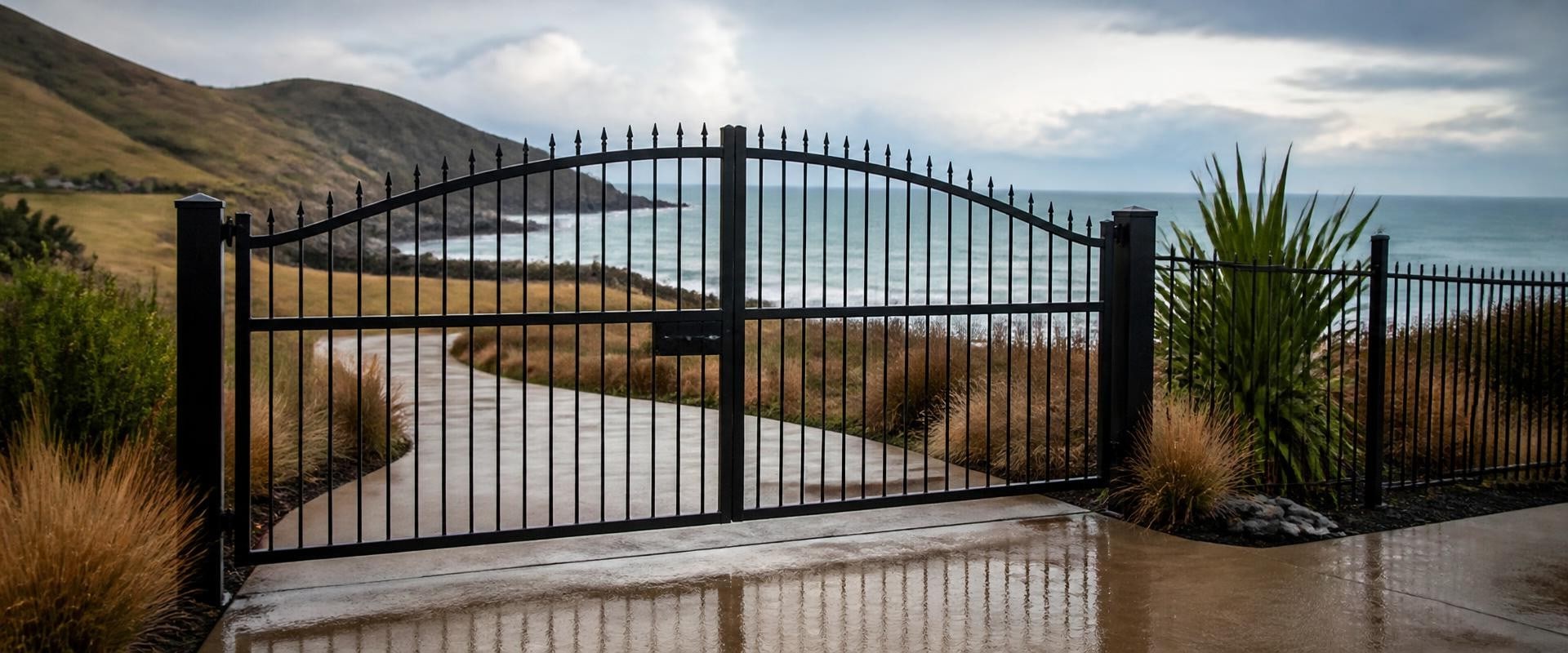
If you live within a few streets of the water in Napier, Westshore, Haumoana or Te Awanga, you have probably seen it already: a gate hinge weeping orange onto the post, a powder-coated fence gone chalky on the sea side, a latch that has seized. Metal fences and gates do last by the coast. They just have to be specified for the coast, and looked after a little.
This is what decides whether a metal fence or gate in coastal Hawke's Bay still looks right in fifteen years.
How close is “coastal”?
Closer and further than most people think. NZS 3604, the standard builders work to, puts everything within 500 metres of the sea (harbours included) and within 100 metres of tidal estuaries and sheltered inlets in its highest exposure zone, zone D. BRANZ notes that wind can carry salt more than 20 kilometres inland, so a section a few kilometres back from Marine Parade still gets some.
Breaking surf makes it worse. Under the corrosion categories in AS/NZS 2312, a surf beach can push “high” corrosion conditions several hundred metres to about a kilometre inland, where a calm harbour might only reach 50 metres. The open beaches from Westshore down to Haumoana and Te Awanga are surf beaches.
You do not have to guess. BRANZ publishes a corrosion zone map where you can look up your own address. Do that before you choose materials, and tell whoever is building the fence what zone you are in.
Steel or aluminium?
Both work by the sea. They fail differently, which changes what you ask for.
Steel rusts. Bare mild steel near the beach will show rust within months, so everything comes down to the coating. Aluminium does not rust. It forms a thin oxide skin, and when salt gets through, it pits and grows white powdery spots instead of losing metal evenly. That is slower and less ugly than rust, but it still spoils a finish and can undercut the coating from a chip.
Steel is usually the better choice for a heavy driveway gate, a long sliding gate or anything that takes knocks, because it is stronger for the same size. Aluminium suits long runs of fence and pool fencing, where light weight and low upkeep matter more.

For steel: galvanise first, then powder coat
The standard for hot-dip galvanising is AS/NZS 4680. It sets a minimum average zinc coating of 85 microns on steel thicker than 6 mm and 70 microns on steel between 3 and 6 mm. The zinc wears away slowly and protects the steel even where it is scratched.
How slowly depends on where you are. BRANZ measured first-year zinc loss in New Zealand anywhere from 0.1 to 20 microns a year, with the worst rates in severe marine sites. Its 2016 to 2018 field work found coastal corrosion rates were higher than in the 1980s.
On the coast, the answer is a duplex system: hot-dip galvanised steel with a powder coat over it. Industry figures put the life of the two together at about one and a half to two and a third times the life of each one added up, because the paint keeps salt off the zinc and the zinc stops rust spreading under any chip in the paint. Ask for it by name. A gate that is only painted, or only powder coated over bare steel, will not last on a beachfront.
For aluminium: the coating and how you care for it
Most aluminium fencing in New Zealand is powder coated. Anodising is the other option, and long-term New Zealand testing has shown well-sealed anodising holds up well in marine conditions. Whichever you choose, read the warranty before you sign. Coating makers tie their warranties to how close you are to the sea and how often you wash the fence. Some fence ranges ask for a monthly wash within 500 metres of the ocean.
The small parts fail first
Hinges, latches, bolts and screws usually go before the fence does. On the coast:
- Use 316 stainless steel, not 304. Grade 316 contains 2 to 3% molybdenum, which makes it much better at resisting the pitting that salt causes. Grade 304 near the beach tends to “tea stain”, a brown film that is mostly cosmetic but looks neglected quickly.
- Keep different metals apart. Where stainless steel touches galvanised steel or aluminium in salty, damp conditions, the less noble metal corrodes faster. BRANZ suggests nylon washers, plastic or rubber gaskets and bushes, or a coating at the joint, so the metals never touch directly.
- Design out water traps. Joints and hollow sections that hold water and salt rust from the inside. Drain holes in the bottom of a gate frame are easy to add when it is made and hard to add later.
How often to wash it
Salt sitting on a fence is what does the damage, and rain only rinses the parts it reaches. Sheltered spots, like the inside face of a gate under a carport or the back of a fence against the house, often corrode first for exactly that reason.
Dulux Powder's care guide for New Zealand gives these washing intervals for powder coated metal:
| Where you are | Wash every |
|---|---|
| Sea shore with heavy spray, such as a surf beach | 3 months |
| Sea shore with moderate spray | 6 months |
| Inland coastal, mild spray | 12 months |
The method is simple. Wipe off loose dirt with a wet sponge, wash with a soft brush and warm water with a little pH-neutral dishwashing liquid, then rinse with fresh water. No harsh solvents or scourers. While you are there, look for chips. Paint damage that is left lets moisture in behind it, so touch up any chip as soon as you find it.
Before you order a fence or gate on the coast
Get these answers from whoever is making it:
- What corrosion zone is my address in?
- For steel: is it hot-dip galvanised to AS/NZS 4680 and then powder coated?
- For aluminium: what does the coating warranty say about distance from the sea and washing?
- Are the hinges, latches and fixings 316 stainless steel?
- How are different metals kept apart at the joints?
- Does the gate frame have drain holes?
A local fabricator who works with steel every day can answer all of these and build to suit. In Hawke's Bay, Metal Masters supplies, cuts and fabricates steel and offers fencing and gates across the region, so you can talk about the coating and fittings before anything is made.
For a wider look at how fence materials compare over the years, see our guide to what type of fence lasts the longest.