You want an aluminium fence and your section is in Wellington. So it probably sits on a slope, takes the northerly side-on, and is closer to salt water than you think. Will the fence that looks sharp in the brochure still be straight and clean in ten years?
It will, if three things are chosen for the site and not for the photo. They are how much wind the fence lets through, how the panels handle the fall of the ground, and what the coating and fixings are made of. For most Wellington sections that means open pickets or spaced slats on raked panels, with a powder coat rated for your distance from the tide and stainless steel fixings.
Key Takeaways
- About 65% of the land classified on Wellington City Council's wind zone map is Very High or Extra High. A fence that lets wind through copes far better than a solid screen.
- On a slope, raked panels follow the ground and leave no gap underneath. Stepped panels leave a wedge-shaped gap under each one.
- All of Wellington city is in corrosion zone C or D. Near the coast, check what the powder coat warranty says about distance from the sea and about washing.
- A fence up to 2.5 metres high needs no building consent. The district plan still limits most residential fences to 2 metres, and on a front boundary the part above 1.2 metres must be half see-through.
- A pool fence is different. It is a pool barrier, it needs consent, and the council inspects it every three years.
- When two quotes differ, compare post fixing, panel type, coating and access before you compare the totals.
Wind: check your wind zone before you choose a style
Builders in New Zealand work with wind zones set under NZS 3604, the standard for timber-framed buildings. The zones run Low, Medium, High, Very High and Extra High. Above Extra High, a site needs specific engineering design.
Wellington City Council publishes a wind zone map for the city's urban areas. We added up the areas on it in October 2026. Of the land the map classifies, 34% is Extra High and 31% is Very High. Another 17% is beyond the zones altogether and needs specific engineering design. High and Medium share what is left, and none of it is Low. Those are shares of land, not of houses, and they include hill country nobody lives on. Even so, an ordinary Wellington section is a windy one.
The zones are written for buildings, not fences, and BRANZ calls them general classifications. Still, look up your address before you pick a style, and tell the installer what you found.
What the wind changes about the fence
A picket fence, or a slat fence with real gaps, lets most of the wind pass through. A closed slat screen or a solid panel catches it like a sail, and the load ends up in the posts and footings. Expect closer post spacing, heavier posts or deeper footings, and sometimes all of them. If a quote for a solid screen uses the same posts and spacing as an open picket fence, ask why.
Privacy is usually the reason people want the solid screen. A slat fence with narrow gaps gives most of the privacy and still lets air through. On a very exposed boundary, an open fence with planting behind it often does the job better than a screen that fights the wind.
Fences on top of retaining walls are common here, and they take more wind than a fence at ground level. Where the drop behind is a metre or more, the fence may also have to work as a safety barrier under the Building Code. Ask which one has been quoted.
Slopes: raked or stepped panels
In hill suburbs such as Brooklyn, Karori and Wadestown, a level fence line is the exception. There are two ways to run aluminium panels down a slope.
Stepped panels are ordinary flat panels. Each one sits level and drops at the post, like a staircase. The top line steps, and a wedge-shaped gap opens under the downhill end of every panel. On a gentle fall the gap is small. On a steep bank it is big enough for a dog to get under.
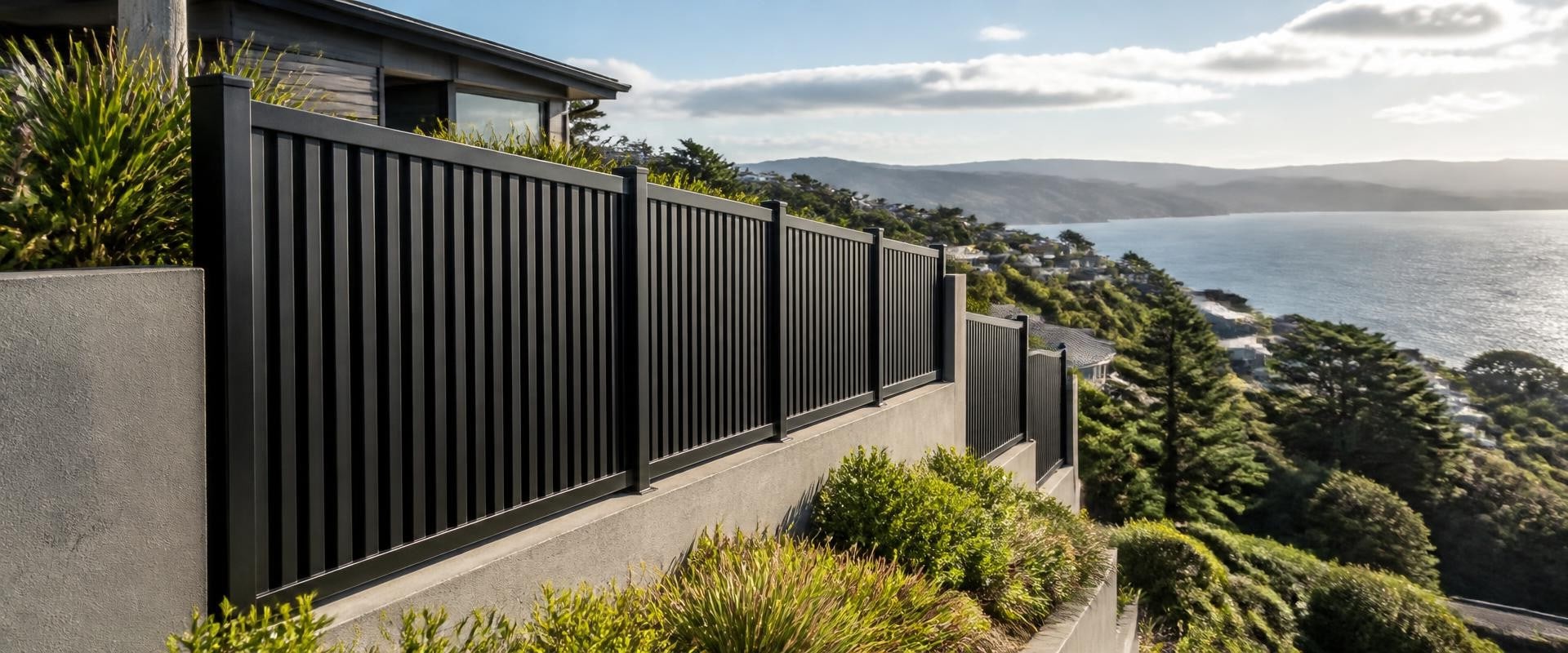
Raked panels are made so the pickets pivot inside the top and bottom rails. The installer leans the panel to match the ground, the pickets stay upright, and the fence follows the slope in one line with no gap underneath. Every panel system has a limit to how far it will rake. Past that limit you need custom-made panels, or a mix of raking and stepping.
Reno Fresh, a Wellington property maintenance company, wrote up a Crofton Downs job from June 2026 that shows the choice well. The section had a significant slope beside a narrow concrete path. They fitted 20 metres of matt black raking panels, because stepped panels would not have given the continuous line the homeowner wanted. The posts were base-plated and bolted to the concrete instead of being dug in beside it, so the path kept its full width.
That last detail is the kind that separates quotes. Digging post holes on a steep bank beside a path is slow, and sometimes there is no room. Bolting to concrete is quicker, but it only works if the concrete is thick and sound, and somebody has to check that on site.
Horizontal slat fences are harder on a slope. Slats cannot pivot, so the panels either step or are made to the angle of the ground. Settle how the panels will run before you compare prices. For more on styles that suit steep ground, see our guide to aluminium fence designs for hilly landscapes.
Salt air: the coating and the fixings
BRANZ places all of Wellington city in corrosion zones C and D, the medium and high zones. Zone D is the strip within 500 metres of the coast, harbours included, and within 100 metres of tidal estuaries and sheltered inlets. The waterfront streets of Oriental Bay, Evans Bay, Lyall Bay, Island Bay and Seatoun are all inside it.
Aluminium does not rust, which is why it suits the coast. The powder coat and the fixings are where coastal fences fail.
Ask which powder coat the panels carry and what its warranty says about distance from the sea. Dulux, for example, rates its standard Duralloy range for sites more than 100 metres from the high tide line, and has a higher grade for sites closer in. A fence 60 metres from the beach in the standard grade is outside what the coating is rated for.
The warranty also depends on washing. Dulux's care guide asks for a wash every 12 months in mild sea spray, every six months in medium sea spray, and every three months near surf. McKechnie, the New Plymouth aluminium extruder, asks for cleaning at least every three months under its powder coat warranty.
One thing surprises people: the sheltered side needs washing more, not less. Rain rinses the exposed face for free. Salt sits on panels under eaves, behind hedges and on the lee side of the house, and Dulux's guide warns that sheltered areas can carry a higher risk of coating damage.
Then the fixings. BRANZ notes that grade 316 stainless steel resists pitting in marine air better than grade 304. Zinc-plated screws in an aluminium rail near the harbour tend to corrode first and stain the panel below them. If the quote does not say what the screws and brackets are made of, ask.
Wellington fence rules: consent, the district plan and your neighbour
You will often see 1.8 metres given online as the height limit for a fence without consent. The Building Act's figure is 2.5 metres, and the number that usually matters in Wellington is the district plan's 2 metres. Four sets of rules can apply.
| Rule | What it says | What it means for an aluminium fence |
|---|---|---|
| Building Act 2004, Schedule 1, exemption 21 | No building consent for a fence up to 2.5 m above the ground it stands on. Pool barriers are excluded. | An ordinary boundary fence needs no building consent. |
| Wellington District Plan, standard MRZ-S10 for the Medium Density Residential Zone (the High Density standard matches) | Within 1 m of a side or rear boundary: 2 m at most. On a front boundary: 2 m at most, and any part above 1.2 m must be 50% visually transparent. The same applies beside public space and open space zones. | Go over 2 m and you need resource consent. On the street front a tall solid screen does not comply. An open picket or a widely spaced slat can. |
| Fencing Act 1978 | Neighbours with no adequate fence between them share the cost of one equally. You serve a fencing notice and the neighbour has 21 days to object. Silence counts as agreement. | Agree the fence in writing before work starts. If you want aluminium where a cheaper fence would be adequate, you may have to cover the difference. |
| Building Code clause F9, pool barriers | At least 1200 mm high. No gap a 100 mm ball could pass through. Gates close and latch by themselves and open away from the pool. At least 1800 mm where the barrier is the boundary fence. Council inspection at least every three years. | A pool fence needs building consent. A wedge gap under a stepped panel can fail the 100 mm test, so raked panels matter here. |
Pool fences on slopes deserve a second look. The 1200 mm is measured from the ground outside the pool area, so rising ground or a low retaining wall beside the barrier can leave it too low. Have the installer confirm the heights on site before the panels are ordered.
The district plan figures are the standard from the council's 2024 plan. A 2026 plan change proposed widening the front boundary strip from 1 metre to 1.5 metres. Check the council's ePlan for the current wording in your zone. Lower Hutt, Upper Hutt, Porirua and Kāpiti each have their own plan and limits.
Why two quotes for the same section can differ so much
On a flat section, aluminium quotes differ mostly on the panel. On a Wellington section they differ on everything around it. Check each of these before you look at the total.
- Post fixing. Dug and concreted, core-drilled into an existing wall, or base-plated and bolted down. Each suits different ground and takes different labour. The quote should say which.
- Panel type. Raked, stepped or made to the slope. A quote for stepped panels and a quote for raked panels are not quotes for the same fence.
- Wind. Post size and spacing for that fence style on your site. Ask what wind zone the installer assumed.
- Coating and fixings. The powder coat range, and the grade of the screws and brackets.
- Access. Many Wellington fence lines cannot be reached by vehicle. Carrying panels, posts and concrete up steps by hand adds labour, and installers allow for it differently.
- Removal and GST. Whether taking away the old fence is included, and whether the price includes GST.
A price given without a site visit cannot have allowed for most of this. That is why quotes for the same Wellington job can sit a long way apart, and why the cheapest is often cheapest because something was left out.
Where this leaves you
Start with the site, not the catalogue. Look up your wind zone, measure the fall along the fence line, and work out how far you are from salt water. Those answers narrow the choice to a fence style, a panel type and a coating grade before anyone quotes.
Then have more than one installer look at it. Put the quotes side by side, ask each installer the questions above, and compare what is included before you compare the price.